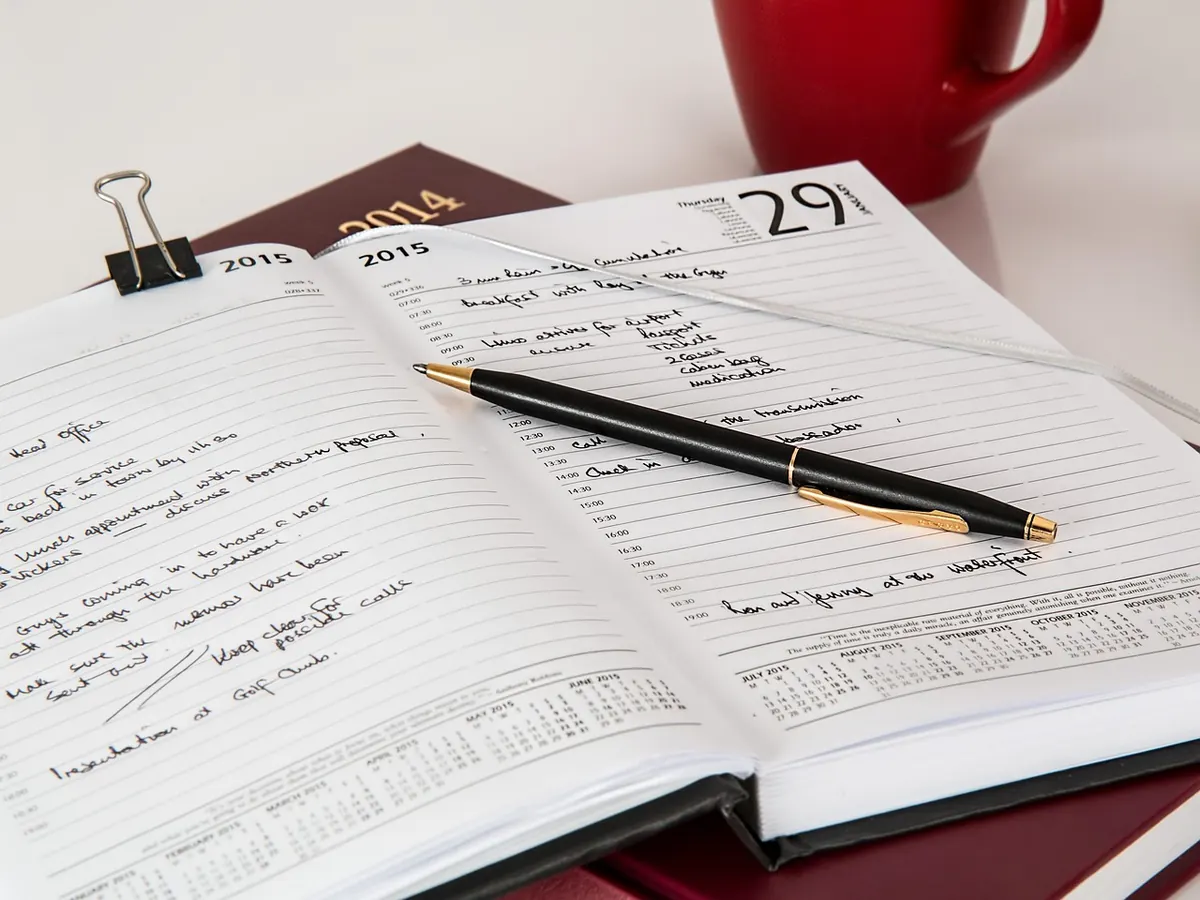
Stand in front of the diary shelf in any stationer's and you're really being asked a question about how you want to think. One notebook offers a blank page for each day, waiting to be filled in as the hours pass. Another hands you a weekly spread, a to-do column and a habit tracker before you've written a word. Both get called diaries. They do quite different jobs.
Plenty of people buy one, feel vaguely guilty by February, and assume the problem is them. Usually it's a mismatch. A planning-led journal suits someone who needs to decide what happens next; a dated diary suits someone who wants a record of what already happened. Getting clear on which you need — or which combination — makes the habit far easier to keep.
Two Formats, Two Different Jobs
The planning-led journal
Think of a bullet journal, a quarterly planner, or any notebook with a weekly spread and room for goals. The defining feature isn't the binding — it's that the pages are usually undated, and the structure asks you to decide what comes next. You set up a month, list what matters, then break it into weeks. Habit trackers, project pages and reflection prompts sit alongside.
The traditional dated diary
A page a day, or a week to view, with the date already printed. There's no setup and no decisions to make before you write. You open it, see the date, and put down what happened: who you saw, how the day felt, what the weather did, the small things you'd otherwise forget by Friday.
The Differences That Actually Matter
- The starting question. A planner journal asks, "What do I want to happen?" A dated diary asks, "What happened?"
- Dates. Printed dates create continuity and a clear home for every day. Undated pages let you skip a fortnight without a gap staring back at you.
- Space. Diaries tend to be tight — a few lines per day. A planner journal is as generous as you make it.
- What a missed day looks like. A blank dated page is a visible reproach. A blank page in an undated notebook is simply a page you haven't reached yet.
- Finding things later. A dated diary is chronological by default; you can find 14 March without thinking. In a planner journal, you'll want an index and numbered pages if you plan to reread it.
- Effort before you begin. Dated diaries need none. Planner journals need a setup session — enjoyable for some, a hurdle for others.
Where a Planner Journal Wins
If your head is full of things that need doing, planning-led pages earn their keep. Say you're juggling a course, a part-time job and a half-marathon training plan. A weekly spread lets you see all three at once, spot the collision on Thursday, and move the long run to Saturday morning before the week starts arguing with you.
These notebooks also suit people who dislike writing prose. A planner journal rewards bullets, ticks, arrows and three-word notes. If sitting down to write a paragraph feels like homework, that's a strong signal.
Their weakness is drift. With no printed dates, nothing pushes you back to the page. A fortnight off can turn into a season, and the book quietly stops meaning anything.
Where a Traditional Diary Wins
Dated diaries are unbeatable for memory. The structure does the work: one page, one day, a few lines. "Rain all morning. Walked to the post office. Dad rang about the shed. Finished the novel." Multiply that by 365 and you have something you could never reconstruct from memory, no matter how good your recall.
They're also good for mood and gratitude notes, family milestones, and the plain facts of a year. If you're tracking symptoms or medication alongside daily life, keep the record clear and take it to your GP rather than drawing conclusions from it on your own.
The trade-off is space. Try to plan a six-week project inside a page-a-day diary and you'll be writing sideways in the margin by Tuesday.
Combining Both Without Carrying Two Books
You don't have to choose. A few arrangements that hold up in practice:
- One dated diary, one running list. Keep appointments and events in the diary itself, and use the inside front cover for a rolling to-do list you rewrite when it gets messy.
- A planner journal with dated entries. Write the date at the top of each entry and you gain a chronological record without printed pages. Add a monthly "what happened" page to summarise.
- Two books, two jobs. A slim week-to-view stays on the desk for appointments and deadlines. A separate journal lives by the bed for evening writing. The rule matters more than the notebooks: plans in one, reflections in the other.
- A monthly bridge. At the end of each month, spend ten minutes copying the highlights and the unfinished business from your planner into a dated log. That single habit gives you the best of both.
Three Questions to Ask Before You Buy
- Do you want to plan forward or record back? Be honest. Whichever answer comes first is probably right.
- How much do you write in one sitting? Two sentences points to a dated diary. Half a page of lists points to a planner.
- What happened last time? If you abandoned a dated diary because blank pages nagged at you, choose undated. If you abandoned a blank notebook because you never knew where to start, choose dates.
A Practical Way to Start
Pick one format and give it a fortnight before you spend anything more. Ten minutes a day, at the same time, is enough to show whether the structure fits. Keep the pen clipped to the book so there's no hunt for one, and don't worry about handwriting or neatness — nobody is marking this.
At the end of the two weeks, review honestly. Were you writing more about what you planned or what you did? If the planning pages stayed empty and the notes filled up, you want a dated diary. If the notes are sparse and the task lists are busy, you want a planner. And if both felt useful, run the two-book version for a month and see whether the extra notebook earns its place on your desk.
The right answer is the one you'll still be using in November.
Photo: stevepb / Pixabay